
A tile sample book that is hard to flip through gets left in the car. That is the honest truth about this product. A distributor hands it to a client, the client fumbles with a stiff spine or a page that will not lie flat, and the book goes back in the bag unsold.
A tile sample book is a bound set of pages, each holding mounted tile samples, used to show a tile range to customers without carrying full-size tiles. Three decisions decide whether it sells: the size, the page count, and the binding. Get those right and the book does the selling for you.
Most buyers pick these three things by guess. Here is how to pick them on purpose.
Start with the size
Size decides where the book lives. On a counter, in a briefcase, or in a customer’s hands at a job site. Pick the wrong size and the book is either too heavy to carry or too small to show the sample properly.
What size should a tile sample book be?
A tile sample book holds cut-down samples, not full tiles. The largest sample most books take is around 200 x 700 mm, the size of a wood-look plank. Everything else is smaller.
A4, at 210 x 297 mm, is the standard page. It holds the common sample sizes, from 100 x 100 mm up to 200 x 200 mm, plus thin color strips. Most showroom and distributor books are A4.
A5, at 148 x 210 mm, is the pocket size. A salesperson carries it door to door. It holds one smaller sample per page, up to about 100 x 150 mm.
For a 200 x 700 mm plank sample, neither A4 nor A5 is tall enough. You need an elongated page sized to the plank, so the sample sits flat without hanging off the edge. This is a custom page size, and it is worth getting right, because a sample that overhangs the page gets bent at the corners.
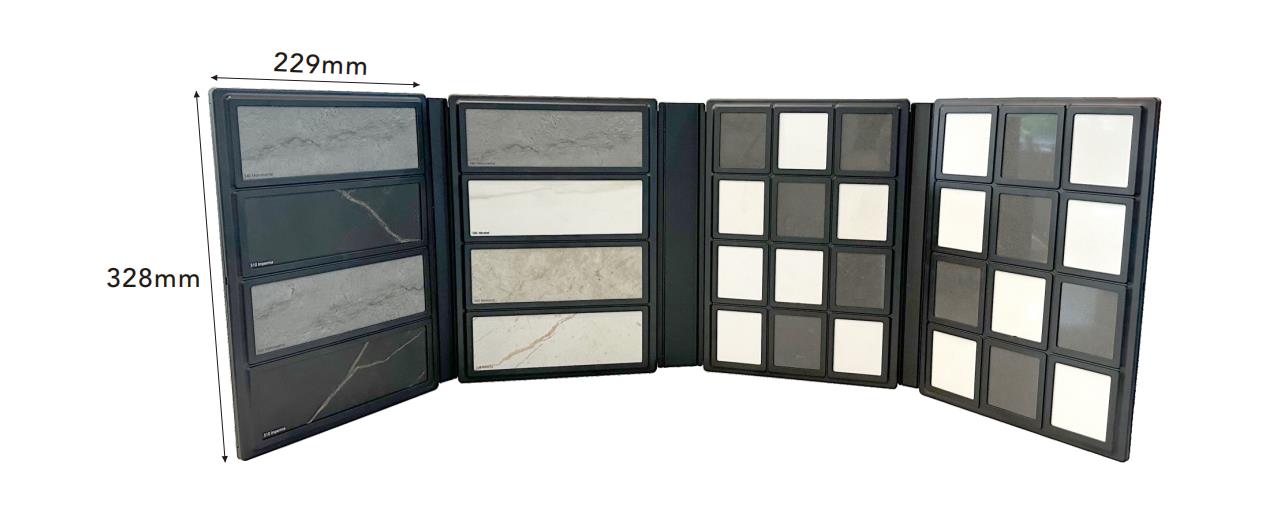
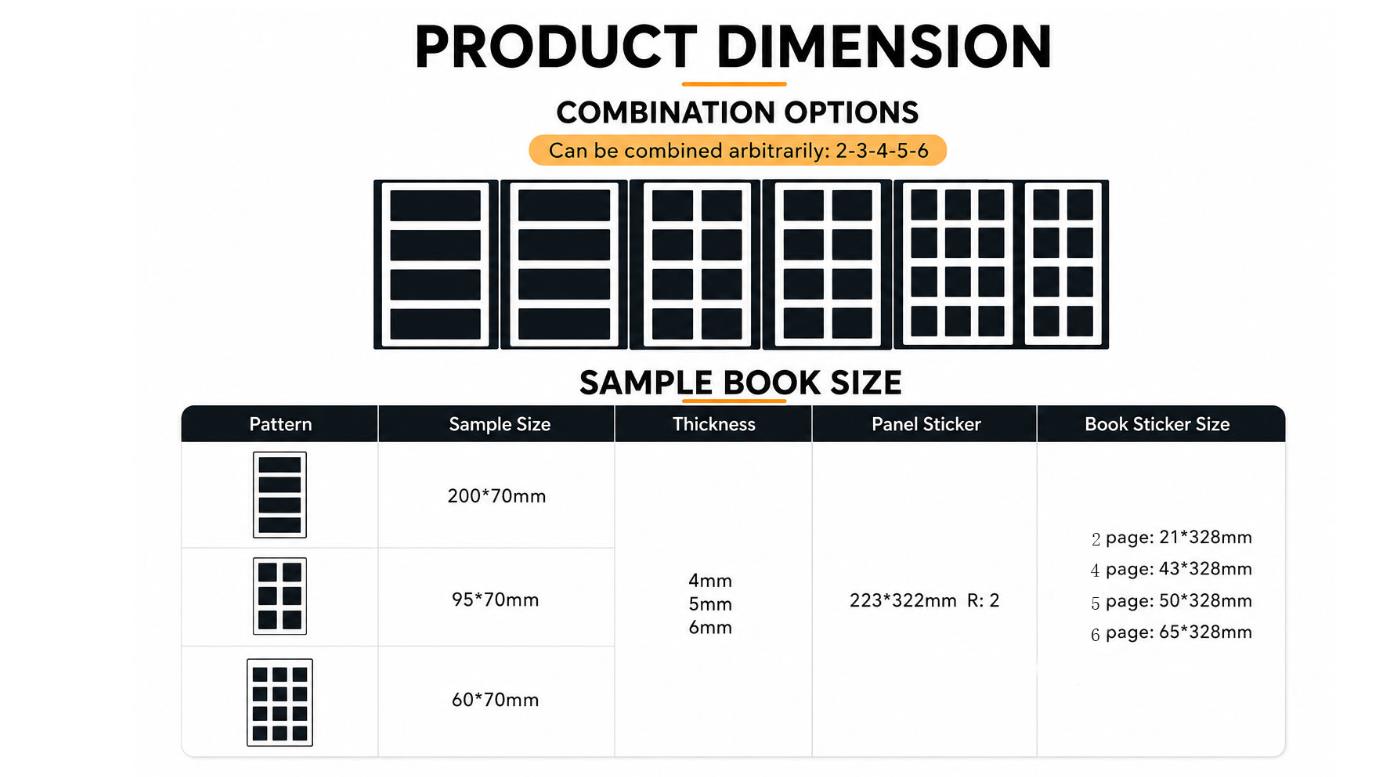
Which sample fits which page?
Match the page to the biggest sample in your range, then smaller samples sit fine on the same page.
| Sample size | Recommended page |
|---|---|
| 100 x 100 mm and smaller | A5 or A4 |
| 150 x 150 mm, 200 x 200 mm | A4 |
| 200 x 700 mm plank and similar | Elongated custom page |
Key Takeaway: A sample book holds samples, not full tiles. The biggest sample most books take is around 200 x 700 mm. Match the page to your largest sample, and A4 covers most ranges.
Decide how many pages
A tile sample book holds few pages. Each page is a thick board with a tile sample mounted on it, so the book gets heavy fast. Most books top out at six pages, and six is usually enough.
How many pages should a tile sample book have?
Think of each page as one tile. A six-page book shows six samples, or twelve if you mount a sample on both sides of each page. That covers a focused range: a few colors, a few finishes, or one series per book.
The limit is thickness, not choice. Each page is a board carrying a real tile sample, so a six-page book is already a solid block. Add more and it stops feeling like a book and starts feeling like a stack of boards.
Why page thickness matters more than page count
A page is not paper. It is a board with a tile glued to it, so each page runs several millimeters thick. Six mounted pages make a book that is noticeably heavy. That weight, not a page number, is the real ceiling on how much you can fit.
If you need to show more tiles, do not force more pages into one book. Split the range across several books, one per series, or point customers to a sample board for the wider range.
Key Takeaway: Six pages is the practical maximum. One tile per page, use both sides if you need more, and split a wide range across books instead of overstuffing one.
Pick a binding that holds up
The binding is where cheap sample books fail. A glued spine splits, pages fall out, and a loose tile sample on the floor is the last impression you leave with a client.
What binding types do tile sample books use?
Spiral and coil binding run a wire or plastic coil through punched holes along the spine. The book opens flat and stays open. This is the everyday workhorse.
Wire-O binding is a double-loop wire that looks cleaner than a coil and holds up longer. It opens flat and feels more premium. Most distributor and wholesaler books use Wire-O.
Screw posts and ring binders let you add, remove, and reorder pages. If you update your range every season, this is the binding that saves you from reprinting the whole book.
Perfect binding glues the pages into a spine like a paperback. It looks like a real book and prints cheaply, but it does not lie flat and the pages can pull loose under repeated flipping.
Which binding lies flat?
A sample book has to lie flat. A client sets it on a counter and compares two tiles across a spread. If the spine fights them, they stop comparing.
| Binding type | Lies flat | Add or remove pages | Durability | Best for |
|---|---|---|---|---|
| Spiral / coil | Yes | No | Good | Everyday counter use |
| Wire-O | Yes | No | Very good | Distributor and premium books |
| Screw posts | Yes | Yes | Very good | Ranges you update often |
| Ring binder | Yes | Yes | Good | Sales kits that change |
| Perfect (glued) | No | No | Fair | Budget catalogs |
Key Takeaway: If the book must lie flat and get flipped daily, pick spiral, Wire-O, or screw posts. Skip perfect binding for anything a client will actually open.
Match the book to how it will be used
The right size, page count, and binding come from one question: who is holding the book, and where.
A salesperson walking a job site wants an A5 book with a few pages and a coil binding, because it fits one hand and survives a toolbox. A showroom counter wants an A4 Wire-O book with up to six pages, because it is the permanent reference for a focused range. A distributor who changes the range every season wants screw posts, because reordering pages beats reprinting.
We have built enough of these to know that a book bought for the wrong use ends up in a drawer. The salesperson wanted a light sample book and got a six-page block that lives in the office. The showroom wanted the full range and got a two-page pocket book. Both wasted the money.
Key Takeaway: Decide who carries the book and where it lives, then let size, pages, and binding follow from that.
Frequently asked questions
What is a tile sample book?
A tile sample book is a bound set of pages with tile samples mounted on each page, used to show a tile range to customers without carrying full-size tiles.
What is the best size for a tile sample book?
A4 (210 x 297 mm) works for most sample sizes and is the most common choice for showrooms and distributors. Use A5 for a pocket sales kit, and an elongated custom page if you carry 200 x 700 mm plank samples.
How many pages should a tile sample book have?
A tile sample book tops out at around six pages, because each page is a thick board with a mounted tile sample. Six pages shows six samples, or twelve if you mount a sample on both sides of each page.
What is the best binding for a tile sample book?
Wire-O or spiral binding, because they lie flat and hold up to daily flipping. Screw posts are best if you update pages often. Perfect binding looks like a book but does not lie flat.
Can I add or remove pages later?
Yes, if you choose screw posts or a ring binder. Spiral, Wire-O, and perfect binding are permanent, so you reprint when the range changes.
What material are the pages made of?
Pages are usually cardboard, grey board, EVA, or plastic, chosen by weight and whether the tile is glued or slid into a pocket. Thicker board feels premium and adds thickness.
Can I print my logo on a tile sample book?
Yes. The cover takes printed logos, brand colors, and company details, and most manufacturers print directly onto the cover or onto a wrapped cover. Logo placement is standard on custom books.
The bottom line
A tile sample book earns its cost every time it makes a tile easy to see and easy to compare. The size, the page count, and the binding are not details. They are the whole product.
Start with who carries the book and where it is used. Pick A4 for the counter, A5 for the road, and an elongated page if you carry plank samples up to 200 x 700 mm. Keep the book to six pages or fewer and check the closed thickness. Choose a binding that lies flat and survives being opened a few hundred times.
If a book is not the right tool for a looser range, a sample box can hold loose samples instead. If you are not sure which combination fits your range, send us your sample sizes and how many series you carry. We will spec the book so it opens flat, fits the bag, and sells the tile.